Lush Banner Blog

Know Your Audience: What Conference Attendees Notice Most About LED Displays

Written by

In a crowded conference environment, attention is the most valuable currency.

Dozens, sometimes hundreds, of brands are competing for the same audience, all using bold visuals, messaging, and technology to stand out. Among these tools, LED displays have quickly become one of the most powerful ways to capture attention.

But here’s the question most brands get wrong: What actually makes people stop and look at an LED display?

This guide breaks down what conference attendees actually notice, and how to design LED display content that works.

1. Movement (But Only When It’s Purposeful)

Motion is often the first thing that catches the eye, but it can also be the fastest way to lose attention.

Random or overly fast animations create visual noise. Attendees may glance at the screen, but they won’t engage or remember the message.

What works better:

  • Slow, intentional motion
  • Looping transitions that are easy to follow at any point
  • Subtle animations that support the message and guides the eye

2. Clarity of Message

The biggest mistake brands make? Overdesigning. After motion grabs attention, clarity determines whether someone stays.

Most attendees are walking by at a distance. If they can’t understand your message within 2–3 seconds, they move on.

High-performing LED displays:

  • Use minimal text (5–7 words max per screen)
  • Focus on one core message
  • Prioritize readability over design complexity

3. Visual Hierarchy

Attendees don’t read, they scan. Your display needs to guide their eyes, if everything is competing for attention, nothing stands out.

  • Headline first
  • Visual second
  • Supporting detail last

4. Scale and Visibility

LED displays are powerful because of their size, but that only works if the content is designed for distance. Attendees often view screens from across aisles, while walking past, and at an angle.

Design for visibility:

  • Large typography
  • Simple layouts
  • Strong focal points

If your design only works up close, it’s not working.

Motion Graphics vs Static Content: What Works Best?

This is one of the most common questions brands ask: Should we use motion graphics or static visuals? The answer is not one or the other, it’s how you use both.

When Motion Graphics Work Best

Motion graphics are most effective when your goal is:

  • Attracting attention from a distance
  • Showcasing dynamic products or services
  • Creating a modern, high-tech brand presence

Examples:

  • Product demos
  • Brand storytelling loops
  • Visual transitions between messages

Key rule: Motion should enhance the message, not replace it.

When Static Content Performs Better

Static visuals are often more effective when your goal is clarity, they give attendees time to process information quickly, especially in fast-moving environments.

Use static (or mostly static) content when:

  • You need to communicate information quickly
  • Your message is text-heavy
  • Attendees are moving fast

Examples:

  • Pricing or offers
  • Key messaging
  • Calls to action
  • Directions (e.g., “Demo Here”, “Book a Meeting”)

The Best Winning Strategy: Combine Both (Hybrid)

The most effective LED displays use a hybrid approach: Motion to attract and static to communicate. This ensures you capture attention and convert it into understanding.

Examples:

  • Start with a short animation loop to grab attention
  • Pause on a clear, static readable message
  • Repeat and loop in a way that makes sense at any entry point

Think of it as: Attract → Communicate → Reinforce

Designing LED Content for Real Conference Behavior

Designing for LED displays is not the same as designing for print. You are designing for movement, distance, and limited attention span. 

Important Insight:  At events, attendees are not trying to be entertained. They are trying to: Solve a problem, find a vendor, and evaluate options quickly.

Here are key considerations:

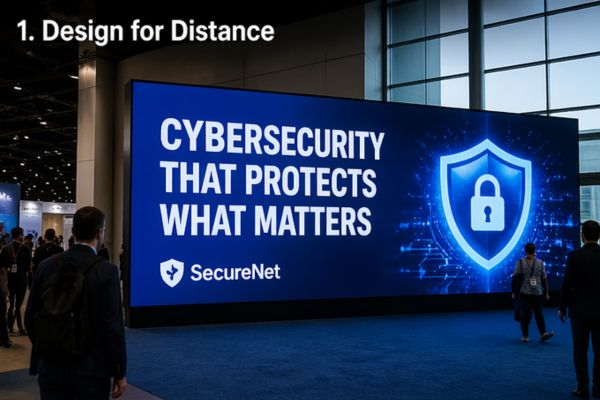
1. Design for Distance

Your content should be readable from at least 10–20 feet away.

Best practices:

  • Large fonts
  • High contrast colors
  • Minimal text

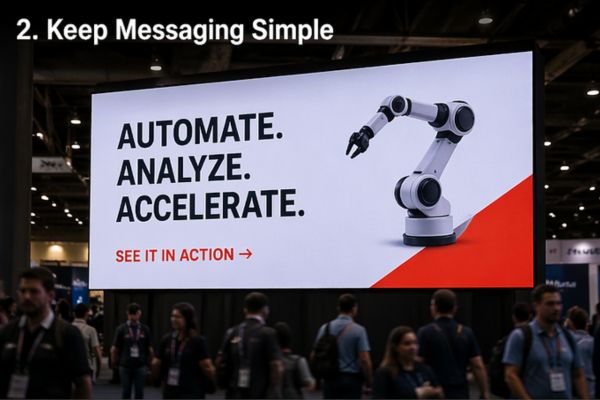
2. Keep Messaging Simple

If your display has more than one idea, it has too many.

Focus on:

  • One headline
  • One supporting visual
  • One action

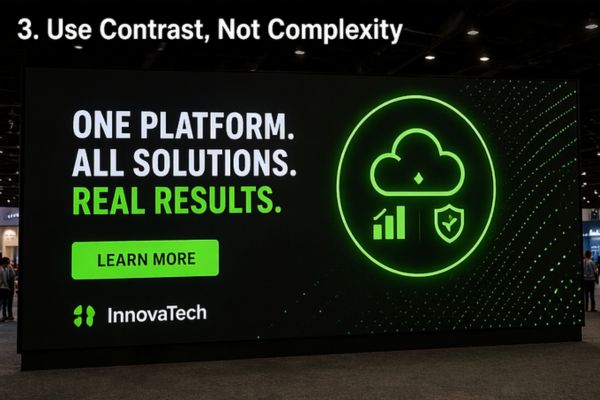
3. Use Contrast, Not Complexity

Bright colors alone don’t guarantee visibility.

What matters is contrast:

  • Light text on dark backgrounds
  • Bold color separation
  • Clean layouts

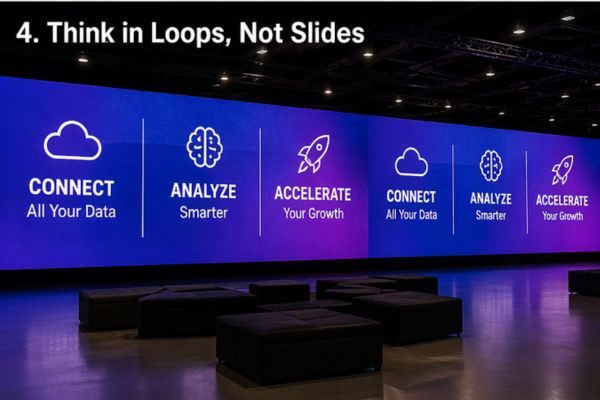
4. Think in Loops, Not Slides

LED content is not a presentation, it’s a loop.

Your content should:

  • Repeat seamlessly
  • Be understandable at any point
  • Avoid requiring a “start” moment

How LED Displays Are Actually Used at Conferenc

Many brands assume LED displays are purely for flashy visuals. In reality, attendees interact with them in different ways.

  1. Attraction Tool: Used to pull people in from across the floor.
  2. Information Display: Used to communicate services, products, and key differentiators.
  3. Brand Reinforcement: Used to create a strong visual identity and consistency.

The most successful booths don’t choose just one use. They design their LED displays to support all three.

Also Read: Are LED Displays Worth the Hype? Pros, Cons, and the Latest Trends

Common Mistakes to Avoid

Many LED displays fail due to avoidable mistakes:

  • Too Much Information: Overloading the screen with text reduces readability.
  • Overly Complex Animations: Complex motion distracts from the message.
  • No Clear Callout: If your display doesn’t clearly say what you do, attendees will move on.
  • Ignoring Viewing Distance: Content must be readable from several feet away.

How LED Displays Fit Into Your Booth Strategy

LED displays work best when combined with other display elements. At Lush Banners, we recommend integrating:

Explore our LED displays, trade show displays, and banner stands to build a complete booth system.

Read our guide on: 6 Most Innovative Display Products Businesses & Organizations Are Choosing Today

Final Takeaway: It’s Not About the Screen, It’s About the Strategy

The best LED displays aren’t just visually impressive, they’re strategically designed for how people actually behave at events.

Attendees don’t remember screens. They remember clear messages, strong visuals, and easy-to-understand value. If your LED display can deliver those within seconds, it will do more than attract attention, it will drive real engagement.

Learn Why LED Displays Are the Future of Trade Show Marketing.

Need Help Designing Your LED Display?

If you’re planning your next conference booth and want help selecting or designing the right LED display setup, we can help you evaluate what works best based on your space, audience, and goals.

Explore our LED Display Solutions or Schedule a Free Consultation with our team.